Greet GEO: Green transition with geothermal energy,financed through the Interregional Innovation Investments (I3) Instrument under the European Regional and Development Fund (ERDF), was coordinated by the Energy Institute Hrvoje Požar.
It ran from November 2024 to October 2026, with a budget of around 1.5 million euros, and brought together ten partners from eight countries: Energy Institute Hrvoje Požar (EIHP), Croatia; La Palma Research Centre SL (LPRC), Spain; Magyar Geotermalis Egyesulet (MGE), Hungary; EMEF Elso Magyar Energetikai Fejlesztő és Szolgáltató Kft., Hungary; DDRIÜ nonprofit KFT., Hungary; Lokalna energetska agencija za Pomurje, Zavod za promocijo in pospevanje trajnostnega energetskega razvoja Martjanci (LEA Pomurje), Slovenia; Consorzio per lo sviluppo delle aree geotermiche (COSVIG), Italy; European Geothermal Energy Council (EGEC), Belgium; BWB Connect CLG, Ireland; Instituto de Inovação Tecnológica dos Açores (INOVA), Portugal.
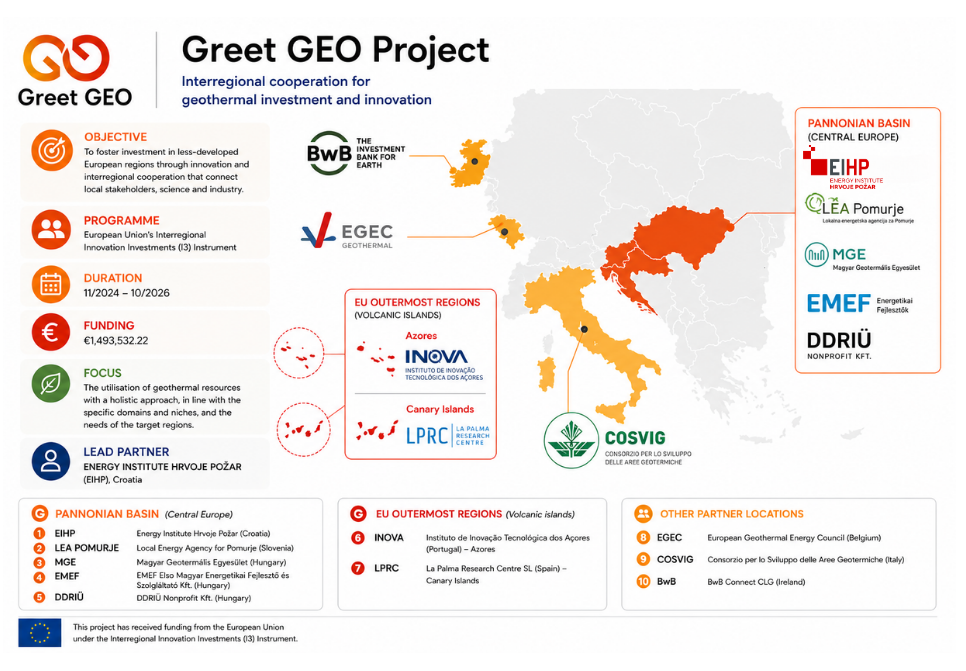
The aim of the project was to strengthen regional innovation ecosystems and accelerate the uptake of geothermal energy across Europe, focusing on supporting small and medium enterprises (SMEs) in less developed Central European regions (Pannonian Basin) and selected outermost regions (Azores and Canary Islands) through a holistic approach to geothermal development.
Greet GEO results
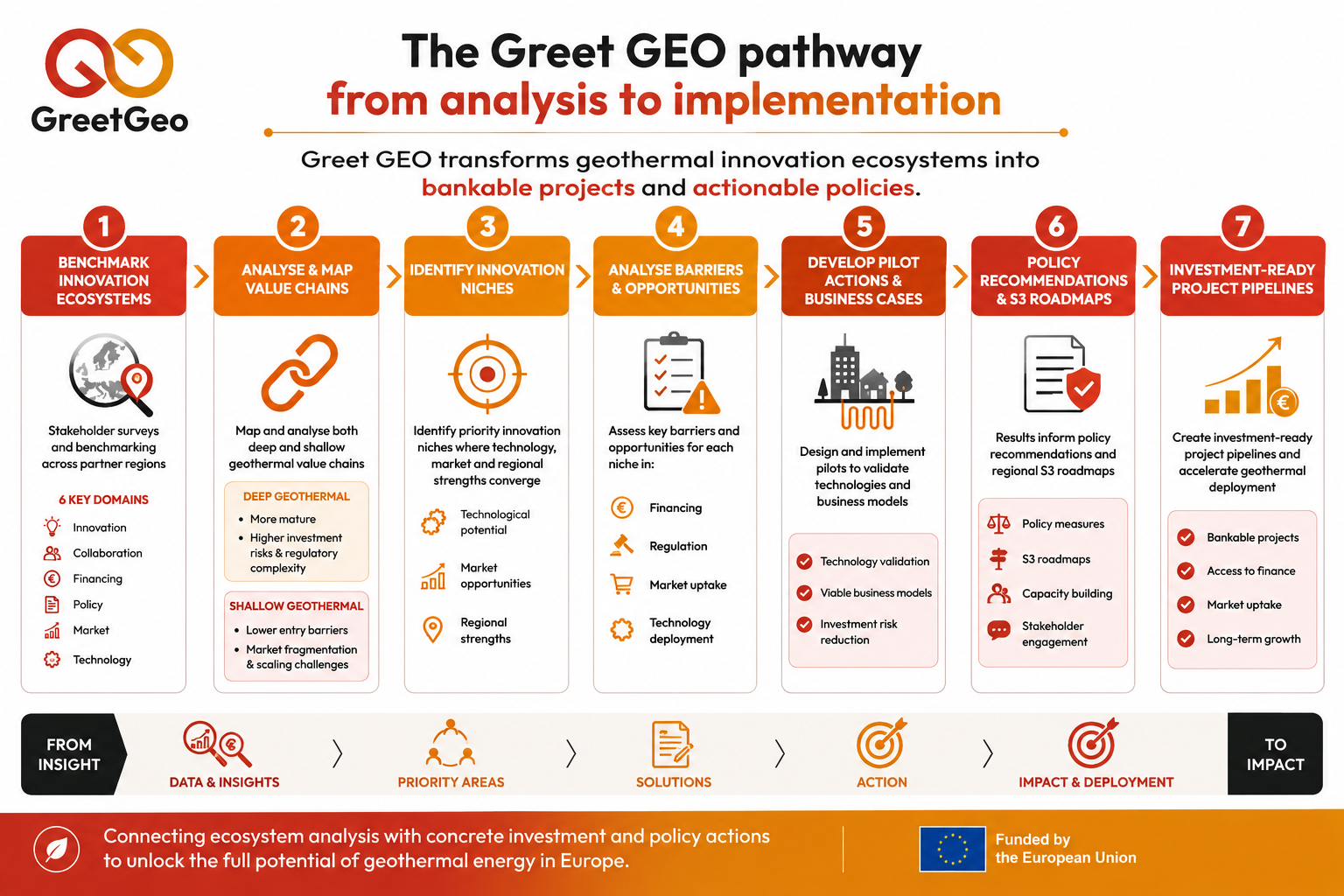
Greet GEO strengthened regional capacity to identify geothermal opportunities, connect relevant organisations and prepare projects for further development. The project addressed both deep and shallow geothermal applications. Its results fall into seven complementary areas.
Market knowledge and innovation opportunities
Greet GEO analysed focus markets (Pannonian Basin countries - Croatia, Slovenia, Hungary, and outermost regions of the Azores and Canary Islands) and mapped geothermal stakeholders across Europe. The result is a geothermal stakeholders database with 533 stakeholders, focused on helping users identify technical experts, technology providers, financing partners and research organisations to develop future consortia.
The survey of 128 stakeholders across Europe assessed six innovation system domains: innovation, collaboration, financing, policy, market and technology. It revealed strong collaboration networks, but moderate innovation capacity and technology readiness, with financing, regulation and market development constraining deployment.
Deep geothermal shows greater technological maturity and market integration, particularly in district heating and industry, but faces complex permitting, high upfront risks and limited dedicated financing. Shallow geothermal benefits from more favourable regulation and lower entry barriers, yet fragmented demand, limited scaling mechanisms and underdeveloped markets hinder its growth.
Value chains and business cases
Drawing on the survey responses, the analysis identified market needs, regional capabilities and barriers to deployment across power generation, heating and cooling, brine valorisation, agriculture and industrial applications.
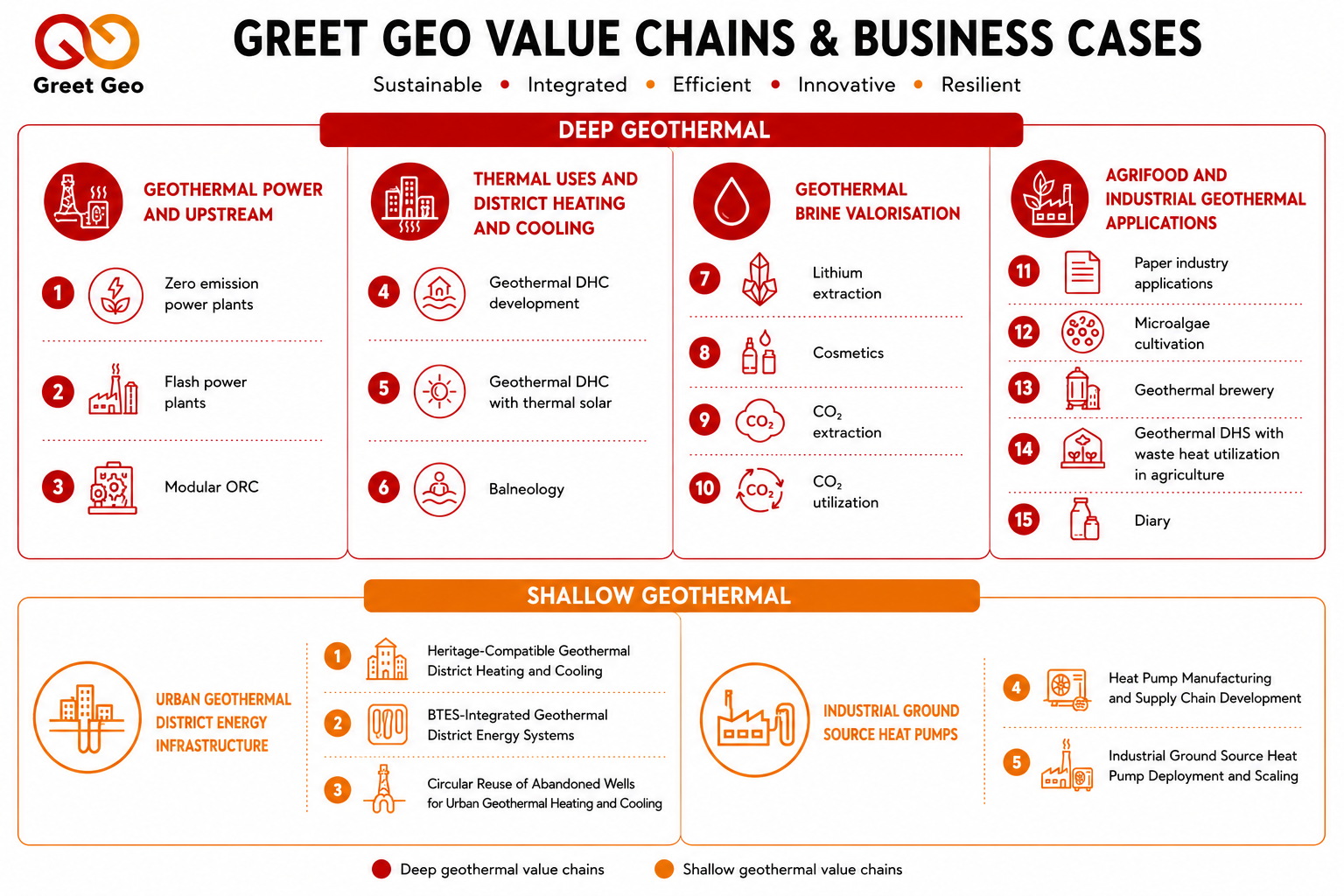
Within Greet GEO, six geothermal value chains and 20 concept-level business cases were developed: 15 covering deep geothermal applications and five covering shallow geothermal. These connect market needs with possible technical solutions and potential partners, providing starting points for further assessment, consortium development and replication.
Investment action plans
Greet GEO supported five geothermal opportunities in moving towards structured project development: Renkovci (Slovenia), Prešov-Ľubotice (Slovakia), Sátoraljaújhely (Hungary), Topusko (Croatia) and Furnas (Azores, Portugal). Selected for their development potential, preparation levels and possible funding routes, they range from infrastructure reuse to integrated electricity and heat projects.
The project assessed demand, resources, technical maturity, investment needs and remaining barriers. It reviewed investment assumptions, supported business models, identified financing pathways and connected promoters with relevant experts and partners.
Project-specific action plans define preparatory activities, responsibilities and next steps. Development follows progressive risk reduction, with resource performance, technical viability, demand, permitting and financing validated at the appropriate stage before major investment commitments.
Investment assessment support tool
To support investment-assessment approaches, Greet GEO developed the Waste Heat Financial Model. It is an interactive Excel tool for preliminary assessment of geothermal-related waste heat opportunities. It combines technical, operational and financial assumptions to compare project configurations and explore how heat availability, demand, infrastructure costs and financing affect commercial viability. The model helps promoters identify key investment drivers and decide whether to pursue further development, while detailed feasibility, engineering, permitting and financial assessments remain necessary.
Policy and regional strategies
Greet GEO developed 15 innovation policy measures addressing financing, permitting, project preparation, skills, data availability and cooperation. These recommendations give public authorities and regional organisations practical options for improving the conditions for geothermal development.
The work also contributed to Smart Specialisation Strategies (S3): four S3-based geothermal roadmaps were prepared for Croatia, the Azores, the Canary Islands and Tuscany, linking geothermal opportunities with regional innovation priorities, market development, skills, financing and future investment support.
A complementary Action plan for the improvement of the regional innovation ecosystem with special emphasis on de-risking geothermal investment. identified common barriers, including high exploration and drilling costs, limited financial support mechanisms, fragmented permitting processes, insufficient subsurface data, and low public awareness.
To address these challenges, the Action plan recommends establishing risk-sharing schemes, streamlining permitting procedures, improving coordination among authorities, expanding geological data collection and sharing, and enhancing community engagement through early communication, transparency, and skills development.
Stakeholder networks and interregional cooperation
The project established cooperation with GEOSYN and CEEGEO and realised synergies with 27 European projects and initiatives. Partners also initiated the Pannonian Basin Geothermal Alliance and the Pannonian Basin Decarbonisation Hub as routes for continued cooperation. These connections provide a basis for targeted matchmaking, knowledge exchange and future joint proposals.
Skills and knowledge transfer
Greet GEO organised 34 events: workshops, webinars, trainings, roundtables, conferences, forums, and study visits that enabled participants to exchange experience on geothermal applications, development barriers and financing approaches. Training materials, recordings, best-practice videos and other knowledge resources support continued learning and replication.
A model that can be replicated
The Greet GEO approach could be adapted beyond the participating regions and even beyond geothermal energy. Its key lesson is that innovation ecosystems become stronger when regional analysis is connected directly with value-chain development and concrete business opportunities.
The methodology follows a clear sequence: understand regional needs and barriers, identify the relevant actors, map complete value chains, determine missing links, develop business cases and connect them with investment and financing pathways.
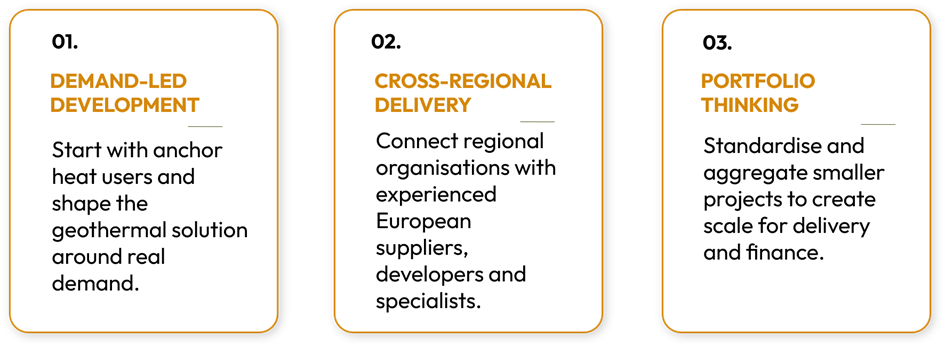
Greet GEO highlighted three practical lessons for advancing geothermal projects towards investment: design solutions around an anchor user’s actual heat demand, connect local organisations with experienced European developers, suppliers and experts, and group smaller projects into standardised portfolios to make them more attractive to contractors and investors.