The Energy Institute Hrvoje Požar (EIHP) is the Lead Partner of the FICHO project (From Inefficient Consumption to Heritage Optimization), which began implementation in mid-2026 and will run for 24 months.
The project is funded under the Interreg VI-A IPA Croatia - Bosnia and Herzegovina - Montenegro Programme 2021- 2027. The total project budget amounts to EUR 1,675,432.20, of which EUR 1,424,117.37 (85%) is provided through Interreg funding (IPA III CBC). This cross-border initiative aims to promote sustainable waste management and circular economy solutions in UNESCO-protected urban areas in Croatia, Bosnia and Herzegovina, and Montenegro.
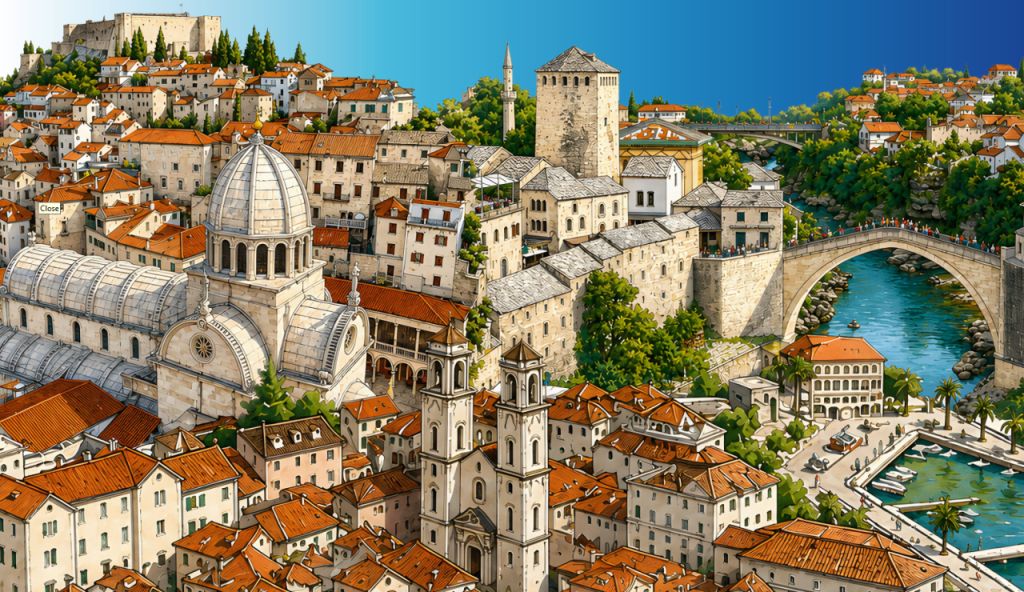
The project areas include Šibenik (Croatia), Mostar (Bosnia and Herzegovina), and Kotor (Montenegro). In addition to EIHP as the Lead Partner, the project consortium consists of the EKO ZH Association (Bosnia and Herzegovina), the City of Šibenik (Croatia), the Tourist Board of the City of Mostar (Bosnia and Herzegovina), the Municipality of Kotor (Montenegro), and the Ruđer Bošković Institute (Croatia).
The project specifically aims to:
- demonstrate the effectiveness, sustainability and transferability of heritage-sensitive circular economy solutions in UNESCO urban areas;
- reduce waste generation and improve waste separation, reuse and recycling through innovative pilot actions;
- strengthen the capacities of local authorities and public service providers to implement circular economy practices;
- engage citizens, businesses and tourists in sustainable consumption and waste prevention; and
- preserve cultural and environmental heritage while supporting sustainable urban development.
Throughout the project, partners will jointly develop and test innovative solutions, including smart waste segregation systems, low-impact municipal waste collection schemes, a Mobile Reuse & Repair Point, Green Label certification for local businesses, and participatory Eco Labs designed to foster stakeholder involvement in the circular economy transition.
A major project outcome will be the development of a Zero Waste Roadmap and a Digital Decision Matrix Tool, which will provide municipalities and municipal waste management operators with practical guidance for planning and implementing circular economy measures in heritage-sensitive urban environments. These tools will be validated through pilot activities and designed for replication in other municipalities across the wider programme area facing similar environmental and tourism-related challenges.
Alongside demonstration activities, the project will deliver training programmes for local authorities and public service providers, educational workshops for schools, awareness-raising campaigns for local communities, and dedicated initiatives aimed at engaging tourists as active partners in protecting UNESCO sites. Stakeholders will gain access to project-developed methodologies, tools and good practices supporting the practical implementation of circular economy principles in their territories.
By combining scientific expertise, local knowledge, stakeholder participation and cross-border cooperation, FICHO will contribute to cleaner urban environments, improved resource efficiency, stronger institutional capacities and enhanced protection of UNESCO cultural heritage. The project supports the objectives of the European Green Deal and the Circular Economy Action Plan while creating a transferable model for sustainable waste management in heritage cities across the Adriatic region.